

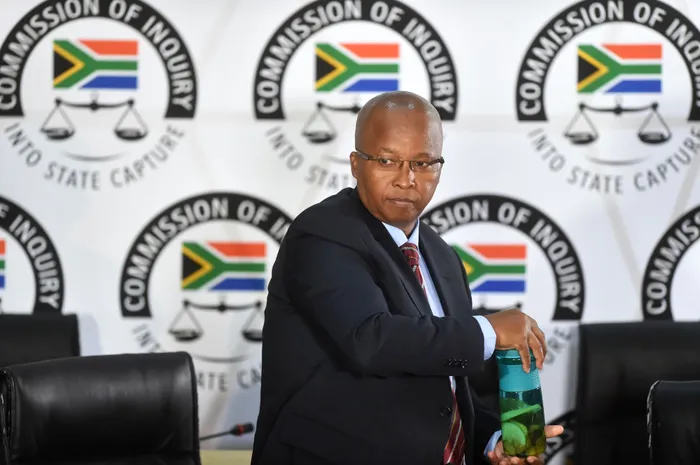
Acting Director-General at the State Security Agency (SSA), Loyiso Jafta, testified at the TRC Cases Inquiry, where he denied efforts to frustrate TRC-related investigations during his tenure in the Presidency.
Image: Itumeleng English / ANA Studio
Following a month-long break due to alleged scheduling issues, the TRC Cases Inquiry resumed on Wednesday with testimony from State Security Agency Deputy Director-General (DDG) Loyiso Jafta.
During his hour-long evidence-in-chief, Jafta, who served in the Presidency during former president Thabo Mbeki's administration, denied alleged interference by Mbeki's administration in the probe of TRC-related cases.
Jafta served as chief director of Policy Coordination and Advisory Services, with his testimony coming as Mbeki and Jacob Zuma continue to have the commission chairperson, Justice Sisi Khampepe, removed as chair of the inquiry.
He said that the robust discussions among various government clusters were not indicative of interference with TRC investigations, but merely reflective of differing priorities and responsibilities.
"In accordance with fierce debate, I'm not aware of any department trying to persuade another from performing its duties or anybody trying to persuade the prosecuting authority not to proceed with prosecutions, and as far as I'm aware, I'm certain that there was never an instruction from the police or the investigators not to investigate matters arising from TRC," he added.
Jafta's testimony also reflected the controversial poisoning incident involving the Reverend Frank Chikane in 1989.
He recounted how the incident led to confusion and concern for Chikane, particularly surrounding the actions of the National Prosecuting Authority (NPA).
Jafta told the commission that Chikane's confusion started when former NPA head, Vusi Pikoli, initiated a meeting with him.
However, on the day of the meeting, Pikoli failed to attend and instead sent Advocate Anton Ackerman, who was the head of the Priority Crimes Litigation Unit (PCLU).
As a result, Chikane, who was poisoned while in Namibia, became even more distressed when Ackerman allegedly rebuked him for seeking direct engagement with the junior officials involved in the incident.
Jafta revealed that in his interactions with Chikane, he learnt that the clergyman was uncomfortable with how his matter was being handled.
This was also revealed by Pikoli, who, in March, admitted that several cases linked to apartheid-era crimes, including high-profile cases like the Cradock Four, were not properly handled or pursued due to resistance against prosecutions.
Pikoli further cited his efforts to proceed with the Frank Chikane attempted poisoning case as evidence of the challenges in holding perpetrators accountable after taking office in 2005.
"Reverend Chikane was initially contacted by Vusi Pikoli, who requested an audience for the following day. Reverend Chikane granted this request. However, he was perturbed by the unexpected arrival of Anton Ackerman from the NPA, who showed up for the meeting without prior notice.
"During this meeting, Advocate Ackerman reportedly berated Reverend Chikane regarding his private efforts to engage directly with the specific junior officials who had administered the poison onto his clothing in Namibia," Jafta told the commission.
The core of the interference allegation lies in the claim that the NPA actively stepped in to halt Reverend Chikane's personal attempts to hold the perpetrators accountable, effectively stalling proper prosecution or further exposure of the chain of command behind the poisoning.
Jafta asserted that the continued prosecution of TRC cases would not have undermined nation-building efforts. Rather, he argued, it would have highlighted hidden networks and undercover operations of the liberation movement.
"So, prosecutions would not pose a threat to nation-building, democracy, and all of that. However, as already stated, if you're going to prosecute, as an example, apartheid functionaries, you need to have access to people who are within this very compartmentalised machinery. That's not an easy task to penetrate and pry open those very closed networks."
Having completed his evidence-in-chief just after the morning recess, Jafta is scheduled to return for cross-examination on July 13.

 LGE2026